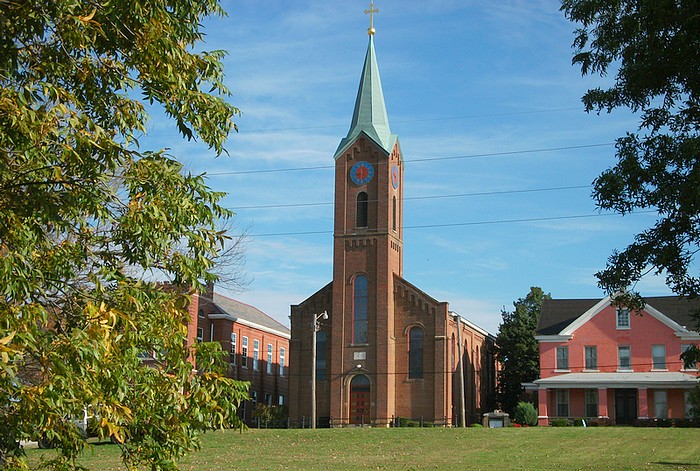
St. Pius Roman Catholic Church
Troy, Indiana
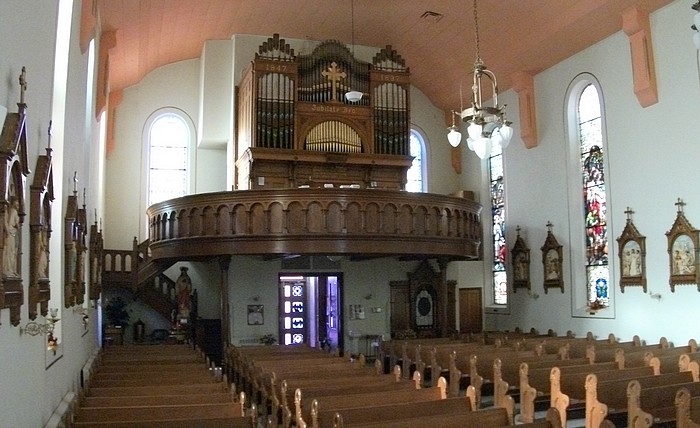
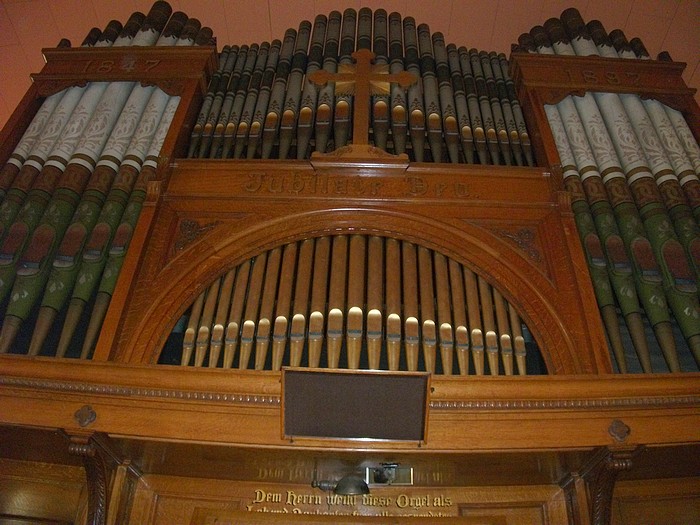
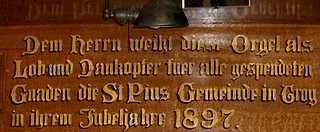
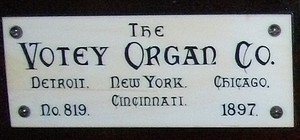
Votey Organ Co. (1897, Opus 819)
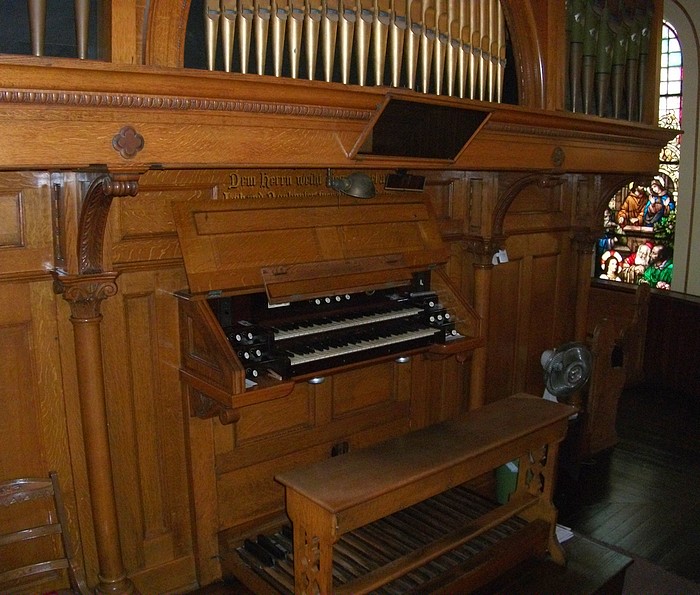
2 manuals. 10 stops. 10 ranks.
Pneumatic chests. Tubular pneumatic key action.
GREAT 58 Notes
(to high a)
(Enclosed in swell box except for Open Diapason)
8' Open Diapason
8' Melodia
8' Salicional
4' Gemshorn
SWELL 58 Notes (to high
a)
(Enclosed in swell box)
8' Violin Diapason
8' Stopped Diapason
8' Dulciana
4' Flute Harmonique
8' Oboe
Tremulant
PEDAL 30 Notes
16 Bourdon
COUPLERS
Great to Pedal
Swell to Pedal
Swell to Great
Swell to Great Octave (4')
FOOT LEVERS
Left: Adds some basic stops, latched
Right: Gt. to Pedal Coupler (reversible I think)
SOUND CLIP
To hear this organ, go to this website and listen to the sample
from Dawn Hymn on disk 2:
http://www.allmusic.com/performance/dawn-hymn-for-organ-op-138-mq0001151503
HISTORICAL BACKGROUND OF THE VOTEY
ORGAN COMPANY
In 1877, at the age of twenty-one, Edwin Scott Votey began
selling organs at the retail and wholesale levels throughout
Western New York. Four years earlier he started his career as an
office boy at J. Estey & Co. who were organ builders in
Vermont.
He was born in Ovid, Seneca County, New York. By 1883, achieving
some success and gaining experiencein the organ business, he
decided to move to Detroit, Michigan where he took out several
patents and organized the Whitney Organ Co. to manufacture reed
organs. The company later changed its name to Farrand &
Votey Organ Co.
Branching out in 1890,
Votey spent six months in Europe studying pipe organs while
selling reed organs. In that same year he began building pipe
organs for churches. Taking out pipe organ patents, his company
built the "great organ" (first to be electronically operated)
used in the Columbian Exposition in Chicago in 1893. At the same
time he invented, built and installed the first Aeolian Pipe
Organ at Aeolian Hall, 18 West 23rd Street in New York City.
In 1896, Votey's professional life began to change dramatically.
In that year he invented the Pianola, also commonly called the
"player piano". He constructed it in his home in Detroit,
Michigan. The following year the Votey Organ Company was
organized by buying out the pipe organ business of Farrand &
Votey Organ Company. The new company was organized to build
Aeolian pipe organs and the Pianolas which were produced in
Garwood, New Jersey. By 1899 the Votey Organ Company was merged
with the Aeolian Company. Votey was elected a director of the
Aeolian Company and a Vice President. The Aeolian Company had an
interna-tional reputation for their organs and pianos.
-From The Summit (N.J.) Historical Society website:
http://www.summitnjhistory.org/Historian_votey.php
Farrand
& Votey began building organs for the Aeolian Company of New
York in the early 1890s. The first was completed in 1893
and was installed in Aeolian Hall. In 1895 Edwin S. Votey
invented the Pianola. This instrument, along with his
development of the Duo Art Organ and Duo Art Piano, placed the
Aeolian Company in the forefront of manufacturers of player
instruments. it also placed Votey firmly on the board of
directors of the Aeolian Company (he became first vice-president
in 1916).
Farrand & Votey remained in business until
1897. After that the Farrand Organ Co. made reed organs,
while the Votey Organ Co. made pipe organs. In 1899 the
Votey company merged with the Aeolian company, and the factory
was located in Garwood, New Jersey. here the Pianola and
other Aeolian instruments were manufactured in quantity.
Aeolian factories were also opened in France, England and
Germany to meet the demand. While the Aeolian firm
continued in this line of activity, the Votey Organ Company
was purchased in 1901 by Hutchings, forming the
Hutchings-Votey Organ Co., with George S. Hutchings as
president and Ernsest M. Skinner as vice president.
-from Orpha Ochse: The History of the Organ
in the United States, p. 296, accessed online at
Google Book Search.
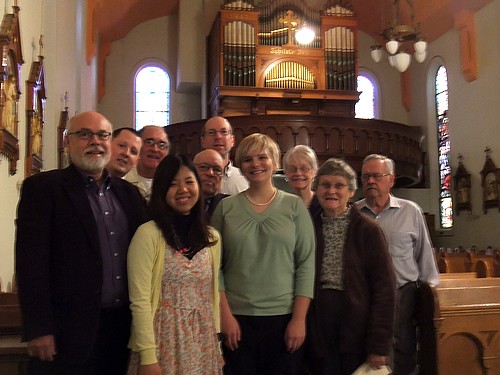
Evansville Chapter's historic organ program at St. Pius
on November 4, 2012
St. Pius Historical Timeline:
1847: Church founded
1881: Cornerstone of the second and present church building was
laid
1884: Current church building dedicated
1885-1886: Bells in the steeple installed, weighing 403,745 and
1,536 pounds
1887: Steeple clock and organ installed
1894: Stained Glass windows installed
1897: Center altar built by Schroeder of Cincinnati: base of
limestone and columns of Georgia marble
Organ basic information from the Organ
Historical Society website:
http://organsociety.bsc.edu/SingleOrganDetails.php?OrganID=7274
Stoplist in part from "Historic Organs of Louisville"
booklet accompanying CD recording,
Produced by the Organ Historical Society:
http://www.ohscatalog.org/hisoroflouis.html
A brief history of St. Pius Church:
http://www.archindy.org/criterion/local/2007/11-02/pius.html
Photos taken by Neal Biggers on October 23, 2012.
Back to Organ Page